
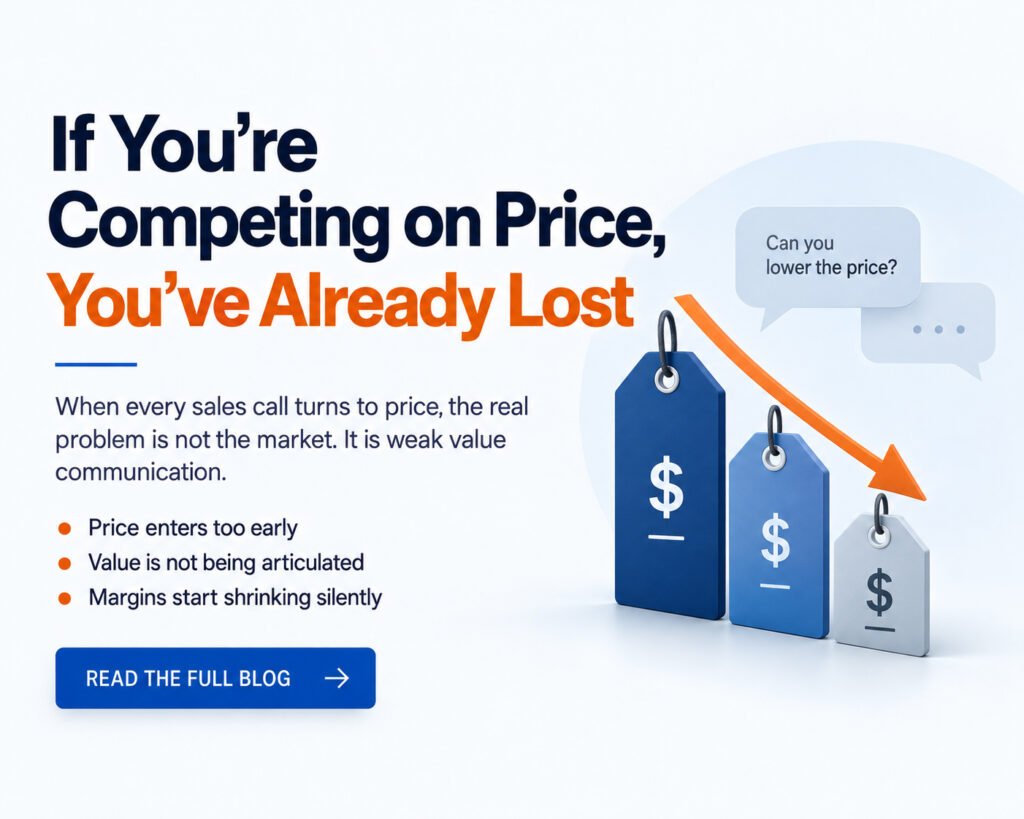

A friend of mine runs a mid-sized company — nothing glamorous, industrial components, the kind of business that quietly crosses a few hundred crores a year and nobody outside the trade has ever heard of it.
A few months ago he did something most owners never actually do. He sat down and listened to a week’s worth of his own sales team’s calls. Not to catch anyone slacking — he just realized he had no idea what a sales call in his own company actually sounded like anymore. He’d been too busy running the place to ever just sit and listen.
Somewhere around the third call, it hit him. Every conversation, without fail, ended up circling back to price within the first ten minutes. New prospect, existing customer, didn’t matter. Somehow they always got there.
Naturally he assumed his pricing was off. Checked it against his two biggest competitors. Nope — he was fine, sometimes even affordable. So that wasn’t it. Which left him with a more annoying question: if price wasn’t actually the problem, why did every single call end up there anyway?
Turns out price isn’t usually the problem. It’s just the thing left standing when there’s nothing else to talk about.
Think about why a price question actually shows up in a conversation. It’s rarely because the customer walked in obsessed with saving a few rupees. It shows up because the conversation ran dry, and price is the one topic that never requires any real thought — you don’t need to know the customer, remember their last order, or understand what’s actually going on in their business. It’s just always sitting there, available. Which is exactly why an underprepared conversation drifts toward it eventually, the way water finds the lowest point.
You can watch it happen almost in slow motion. Sales team opens with the product. Runs through the features — the same features every competitor in the category recites. Customer nods, unmoved, because none of it was actually about them. There’s a little silence. And that silence is where “so what can you do on price” comes from.
Honestly, that silence is the real moment the deal was lost. The price haggling after it is just cleanup.
My friend didn’t fix this by telling his team to hold the line on discounts harder — that’s just squeezing the symptom. What he actually did was try to figure out why his Sales Team had nothing left to say by the ten-minute mark.
A few things shifted after that, none of them complicated. He started paying attention to when price came up in a call, not just whether a deal was eventually lost to it — because a price question at minute two means something completely different from one at minute forty, and he’d never separated the two before. He also realized every Sales person had basically the same answer for “why us” — quality and service, the same three words every single competitor says too — so he pushed each of them to find one real, specific thing they could say instead. For him it turned out to be something almost boring: his team responds to a technical query within the hour, every time, when everyone else in the category takes two days to even reply. Not exciting. But it’s the reason a customer calls him first when something’s gone wrong, price or no price.
The bigger shift, though, was just flipping the order of the conversation. Reps stopped opening with the product and started opening by actually asking what the customer was dealing with that month — a delayed shipment from someone else, a tender they were about to lose on cost, whatever it was. Get the other person talking about their actual problem first, and by the time your product enters the conversation, it’s an answer to something real instead of a pitch competing against whatever number is already in their head.
Price still comes up. Of course it does. But now it shows up around minute thirty instead of minute ten — and by then there are usually two or three other reasons sitting on the table that have nothing to do with the number.
I think about this conversation with him a lot, honestly. Most owners I talk to are convinced they have a pricing problem. Almost none of them actually do. What they usually have is a team that’s excellent at describing a product and not particularly good at holding a conversation — which isn’t the same skill at all, even though we tend to train people for the first one and just hope it covers the second.
You don’t need anything fancy to check this for yourself. Pull up your own team’s recent calls, or just think back honestly to your last few sales conversations if you don’t record them.
Would you find an actual reason to buy in there somewhere — or just a slow walk toward the discount question?
Start with a Business Diagnostic at make10xhappen.in