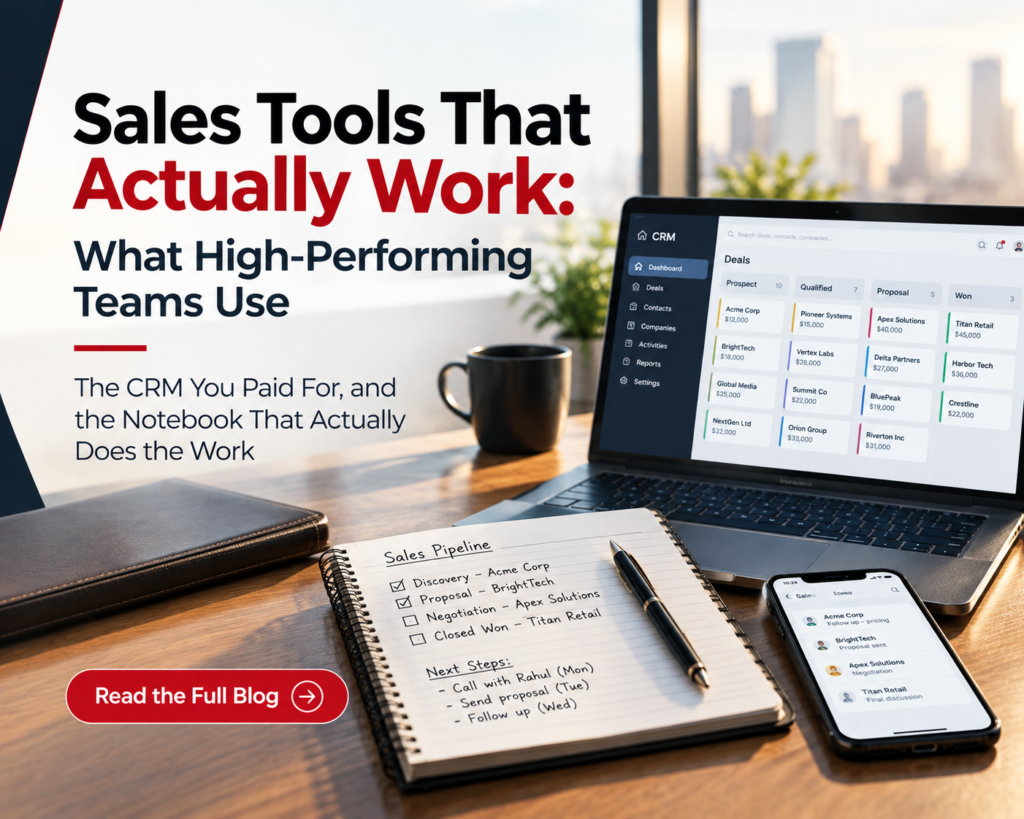

The CRM You Paid For, and the Notebook That Actually Does the Work
Somewhere in your office, a laptop is running the CRM you paid for. Somewhere in your best Salesperson’s bag, a notebook is running your actual pipeline.
You’ve probably bought three different tools in the last few years trying to fix this. Each time, the real deals still ended up living somewhere else — someone’s head, someone’s notebook, a WhatsApp thread nobody else can see.
It Was Never About the Software
Here’s what happened each time: the tool wasn’t the problem. Adoption was. And adoption didn’t fail because your team is lazy or the software was bad — it failed because using the tool made someone’s day harder, not easier, and the only person who benefited from all that extra typing was you.
Think about it from a user’s point of view. Logging a call, updating a lead stage, writing a note — none of that helps them close the deal in front of them right now. It helps you see the deal later. So the moment the initial push from leadership fades, the tool quietly becomes optional, and everyone goes back to what actually gets them through their day.
High-performing teams don’t necessarily have better tools. They have tools that happen to make the rep’s own job lighter — a reminder that saves them from forgetting a follow-up, a template that saves them from writing the same email from scratch. The visibility you get as the owner is a side effect of that, not the reason it got adopted in the first place.
Find Out Why the Last One Actually Died
Before you buy anything new, get specific about why the last tool didn’t click and stick. “Nobody used it” isn’t an answer, it’s a symptom. Was it too many clicks to log one call? Did leadership itself stop using it after month two, which quietly told everyone else it didn’t matter? Was it just duplicating something the team was already doing on WhatsApp or paper, so it felt like double work instead of a replacement?
Each of those has a completely different fix. Buying tool number four without answering this just guarantees you’ll be having this same conversation again next year.
Choose for What It Removes, Not What It Reveals
When you’re evaluating a new tool, the question that matters isn’t “what will this let me see.” It’s “what will this take off my rep’s plate.” A tool that saves someone fifteen minutes a day gets used without anyone asking them to. A tool that only exists to generate a report for your Monday meeting gets filled in five minutes before your Monday meeting, and nowhere near accurately.
If you can’t name one specific thing the tool makes easier for the person actually using it every day, you’re about to buy CRM number four.

Prove It With Two People First
Don’t roll a new tool out to the whole team on day one. Hand it to your two best performers and watch what happens over a few weeks. If your strongest people, the ones who already know how to close, won’t use it consistently without being chased — nobody else on the team will either, and you’ve just learned that for the cost of frustrating two people instead of twenty.
If they do keep using it on their own, you’ve got something better than a vendor’s pitch deck. You’ve got proof, from inside your own team, that this one’s actually going to stick.
One Question Before You Buy Tool Number Four
If your best salesperson quit tomorrow, could someone else pick up their pipeline from whatever’s sitting in your system right now? Or would they have to start from a notebook, a phone, and whatever that person happened to remember on their way out the door?
If you’re not sure, the tool was never really the thing you needed to fix.