

When your sales team goes out every morning – are they going out to sell, or are they going out to remind people why they buy from you?”
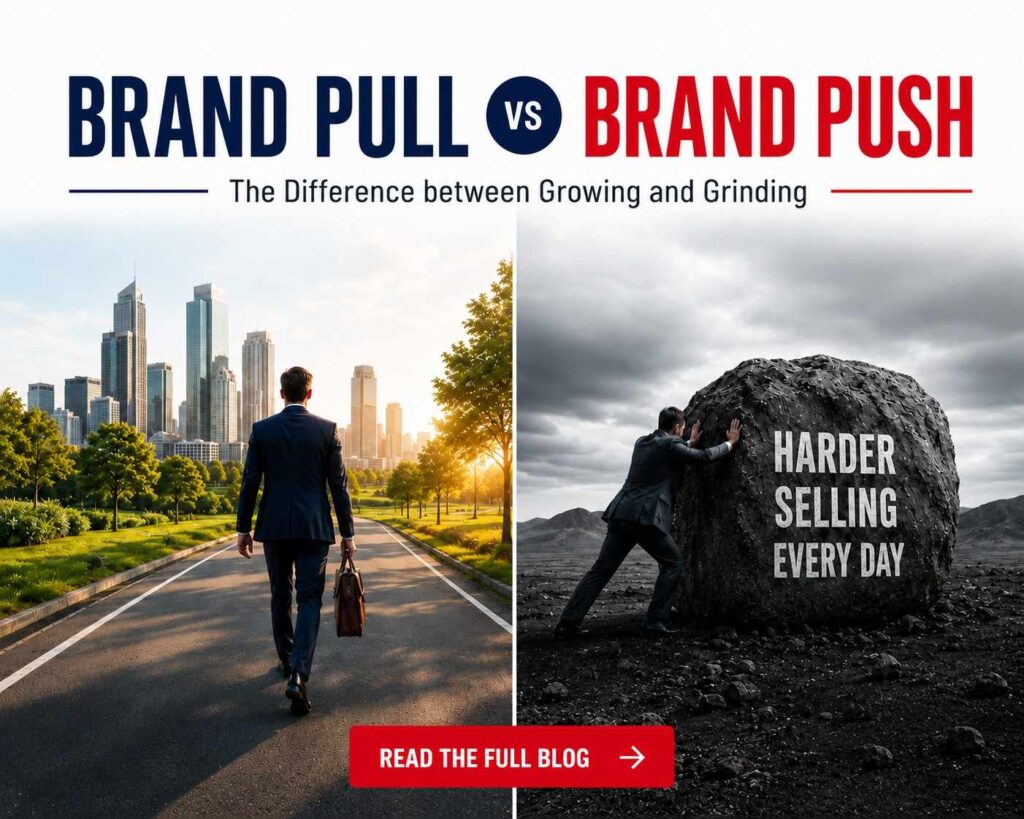
That one question separates two very different businesses. One is growing and the other is grinding.
How the Grinding Business Looks Like
Every month feels like starting from zero. The sales team is constantly on the move—meeting prospects, following up with existing leads, presenting offers, and sometimes lowering prices just to close deals. The business owner stays heavily involved because even a small step back can impact sales. Distributors need regular motivation, retailers need consistent engagement, and even loyal customers often need a reminder or a compelling reason to place their next order.
The business is alive. It’s working but it’s exhausting.
This is Brand Push. You push your product into the market every single day. The moment you stop pushing, the market stops buying.
I’ve seen this pattern across hundreds of mid-sized businesses -‚¹15 crore to ₹200 crore in turnover. The owner is the engine, the brand is invisible, the sales team is essentially a logistics function dressed up as a sales function.

Why the Growing Business Looks Different
Clients call before the sales rep does. Distributors ask for stock rather than being convinced. New retailers want to carry you because they’ve heard your name from other retailers. Your team is not winning, it is closing.
This is the power of Brand Pull. Your brand creates trust and demand long before a salesperson starts the conversation. When people already know and believe in your business, selling becomes much easier.
The difference in daily effort is dramatic but more importantly the difference in margins is dramatic. A brand with pull doesn’t have to discount and need not over-incentivise the channel. A brand with pull grows even when the sales team has one bad month.
Why Most Mid-Sized Businesses Stay Stuck in Push Mode
Most business owners in the 10cr -100cr range built their business on relationships and hustle. That worked, and it got them here.
But somewhere between 30cr and 300cr, the same playbook starts to cost more than it earns. More salespeople, more travel budgets, more schemes, more discounts – the growth curve starts flattening.
The instinct is to push the Sales team harder, run more schemes, and add more feet on the street, while the actual problem is different -the brand isn’t pulling its weight.
When I work with business owners at this stage, one of the five things we focus on through the SURGE framework is –“Elevate Brand Power” not with logo redesigns, not with advertising campaigns but with a very simple question why does a customer choose you over the next option, and does that reason exist in their mind before your salesman shows up?
If the answer is no – you’re in push mode, whether you realize it or not.

What Brand Pull Actually Looks Like in a Distribution Business
I’m not talking about building a consumer brand on television. For mid-sized businesses in distribution-led sectors – FMCG, FMEG, Building materials brand pull is built differently.
It’s the electrician who asks for your wire by name at the counter, because he trusts the quality and knows the coil gives him consistent length. That’s pull.
It’s the retailer who keeps your product at eye level without being asked, because customers ask for it. That’s pull.
It’s the sub-dealer who calls your distributor for stock because his competitors are stocking you and he’s losing walk-ins. That’s pull.
Success doesn’t come from a single campaign. It comes from consistently doing the right things—delivering reliable products, staying visible where customers make buying decisions, educating electricians and end users, and building a reputation that spreads through word of mouth, often faster than any sales team can.
The Shift From Push to Pull: “ Where to Start”
Three things move the needle in most businesses:-
1-Own Your End User
In most distribution businesses, the owner knows his distributors well, his top retailers reasonably well, and his end users not at all. The end user is the one who creates pull. Start there. Know why they choose you. Know what they tell others.
2-Make Your Brand Visible Where the Decision Happens
Not on hoardings on highways, at the retail counter, at the project site, or in the electrician’s tool bag. Brand pull is built at the point of decision, not at the point of awareness.
3-Stop Funding Push with Money that Should build Pull
every rupee you spend on an extra trade scheme to push slow-moving stock is a rupee not spent on building the reason someone asks for you by name. Rebalance that ratio, even by 20%, and the results show within two quarters.
The Hard Truth
Push-driven businesses can last for years, and many of them generate strong profits. But they’re often more vulnerable than they seem. A slow sales season, a competitor with a better offer, or a distributor choosing to work with someone else can quickly hurt revenue. Pull-driven businesses, on the other hand, are built to last. When customers actively seek out your brand, demand keeps coming in even when your sales team isn’t constantly pushing to make it happen.
The question isn’t whether you need a brand pull, however the bigger question is – are you building it, or are you too busy pushing to notice it’s missing?
If your sales team is working harder than your brand, it’s worth taking a serious look at where you are. Start with a quick business health diagnostic and visit our website: make10xhappen.in