
Your Competitor Isn’t Outspending You. They’re Outrunning You.
And the reason isn’t talent, market share, or luck. It’s their systems — and how much time those systems save every single day.
Most mid-sized businesses don’t lose ground dramatically. They lose it slowly. Quietly. Through small inefficiencies that compound over months until the gap becomes impossible to ignore.
That’s exactly what’s happening right now — and it’s happening faster than most business owners realise
The Real Problem Is Not Technology. It’s Operational Drag.

Most growing businesses don’t collapse because they lack opportunity.
They slow down because complexity keeps increasing while systems stay the same.
In the early stages, people compensate for weak processes through hustle. Teams communicate informally. Founders stay close to every decision. Problems get solved quickly because the organisation is still small enough to move by instinct.
Then the company grows.
Suddenly, approvals take longer, and reporting becomes inconsistent. Departments stop sharing information smoothly, and managers spend entire days reviewing updates instead of making decisions.
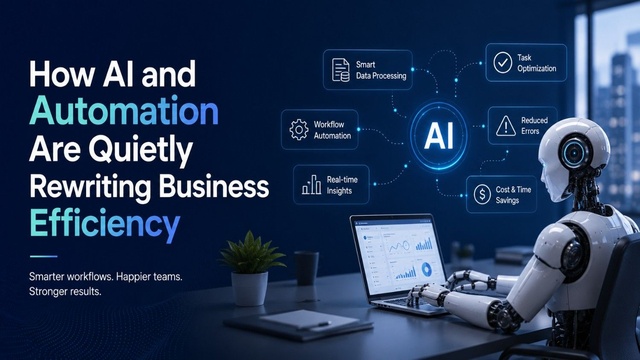
This is usually the stage where businesses start exploring AI and automation in business, even if they don’t formally call it that.
Most Teams Are Busy All Day, Yet Productivity Barely Improves
One of the clearest signs that a company needs better systems is when everyone feels overloaded, but output doesn’t improve proportionately.
This happens more often than founders realise.
People are working. Meetings are happening. Reports are circulating constantly. Yet the business still feels slower than it should.
That’s because a surprising amount of organisational energy gets consumed by repetitive coordination:
- Updating sheets,
- Chasing approvals,
- Compiling data,
- Sending reminders,
- Managing follow-ups,
- Tracking information manually across teams.
None of these tasks is dramatic. But add them up across a mid-sized company — and you’re looking at hundreds of hours a month spent on work that creates zero customer value and zero competitive advantage. That’s the hidden cost most businesses never calculate.
How AI Improves Business Operations in Everyday Situations

A lot of discussions around AI feel unnecessarily complicated, while the practical reality is much simpler.
Understanding how AI improves business operations usually starts by identifying the parts of the business that repeatedly consume time without creating much strategic value.
For example:
- A sales manager spends three hours compiling weekly reports manually.
- A customer support team answering the same basic questions repeatedly.
- Leads entering the system without prioritisation, forcing sales teams to waste time chasing weak opportunities.
These are not dramatic business problems. But they create constant inefficiency, and this is where AI starts helping quietly.
Not by replacing leadership decisions or by removing people entirely.
But by handling repetitive operational layers faster and more consistently than manual systems can, and when such inefficiencies disappear, the organisation starts feeling lighter.
Why Mid-Sized Companies Feel the Pressure More Intensely
Large enterprises usually have layers of systems already built into the business. Smaller companies can still rely on agility and direct communication.
Mid-sized businesses sit in a difficult middle zone.
Growth is happening, but infrastructure often hasn’t caught up yet.
This is why business automation for mid-sized companies has become such an important conversation recently. These businesses are growing fast enough to feel operational strain, but not structured enough yet to absorb it smoothly.
Founders start noticing unusual patterns:
- Teams are becoming dependent on constant supervision,
- Decisions are slowing down,
- Execution is becoming inconsistent across locations,
- Managers are spending more time coordinating than building.
The business keeps moving, but with increasing friction underneath.
That friction becomes expensive over time.
Automation Does Not Mean Removing Human Judgment
One reason many companies delay automation is that they assume it will make the organisation feel robotic.
In reality, the best systems do the opposite.
Strong automation removes repetitive clutter so people can focus on decisions that actually require human thinking.
Good businesses do not need senior people wasting half their day compiling updates or checking routine operational tasks manually.
They need those people solving growth problems, improving customer experience, strengthening execution, and making better strategic decisions.
That shift matters.
Because operational fatigue does not happen suddenly. It builds gradually through small inefficiencies repeated every single day.
At MIH, we address this directly through the R — Recharge pillar of the SURGE Framework.
Recharging your sales engine isn’t just about training or targets. It’s about giving your team the systems and tools to execute consistently. When automation handles the operational layer, your people are finally free to do what they were hired to do: sell, build relationships, and drive growth.
The businesses that implement this see a consistent pattern — not a dramatic overnight transformation, but a compounding improvement in execution speed, decision quality, and team output that builds month on month.
Why Buying Tools Alone Rarely Solves the Problem

This is where many companies get stuck.
They buy multiple automation tools for growing businesses and expect efficiency to improve automatically, but tools without process clarity usually create more confusion.
Different departments start using different systems. Reporting becomes fragmented. Teams rely on disconnected workflows. Leadership still struggles to get clean visibility.
Technology cannot fix structural confusion by itself.
The businesses seeing the strongest results from AI in business operations are usually the ones that simplify workflows first and automate second.
That order matters more than most companies realise.
Because automation amplifies whatever system already exists — good or bad.
The Businesses Moving Faster Today Are Not Always Bigger
One interesting shift happening right now is that speed is no longer directly linked to company size.
Some mid-sized businesses are executing faster than companies much larger than them.
The reason is simple.
Their systems are cleaner.
Information moves faster internally. Teams spend less time coordinating manually. Decisions happen with better visibility. Follow-ups don’t depend entirely on human memory.
This is where AI for business efficiency becomes a competitive advantage instead of just an operational upgrade.
Businesses that remove friction early scale with far less internal chaos later.
The MIH Perspective
At Make 10X Happen, AI is not treated as a trend conversation.
It is viewed as an execution conversation.
We recently worked with a mid-sized distribution business that was spending 14 hours a week on manual reporting. We redesigned the system, time spent dropped to 2 hours. Team productivity improved drastically as focus shifted to market working instead of compiling data. Revenue from existing accounts grew 28% in the following quarter — not because the market changed, but because the team finally had time to serve it properly.
Most businesses already know where operational inefficiencies exist. The challenge is that teams become so used to working around them that the inefficiency starts feeling normal.
That is usually when growth begins slowing quietly beneath the surface.
The role of automation is not to make businesses more technical. It is to make them more efficient, more responsive, and easier to scale.
A Question Worth Asking
If your team is still spending hours every week doing repetitive operational work manually,
How much growth is your business losing simply because nobody stopped to redesign the system?
If that question made you pause — that pause is worth something.
Come find out exactly where your systems are slowing your business down. We’ll map it, diagnose it, and show you what needs to change first.
Book your Growth Diagnostic & Blueprint Session.