
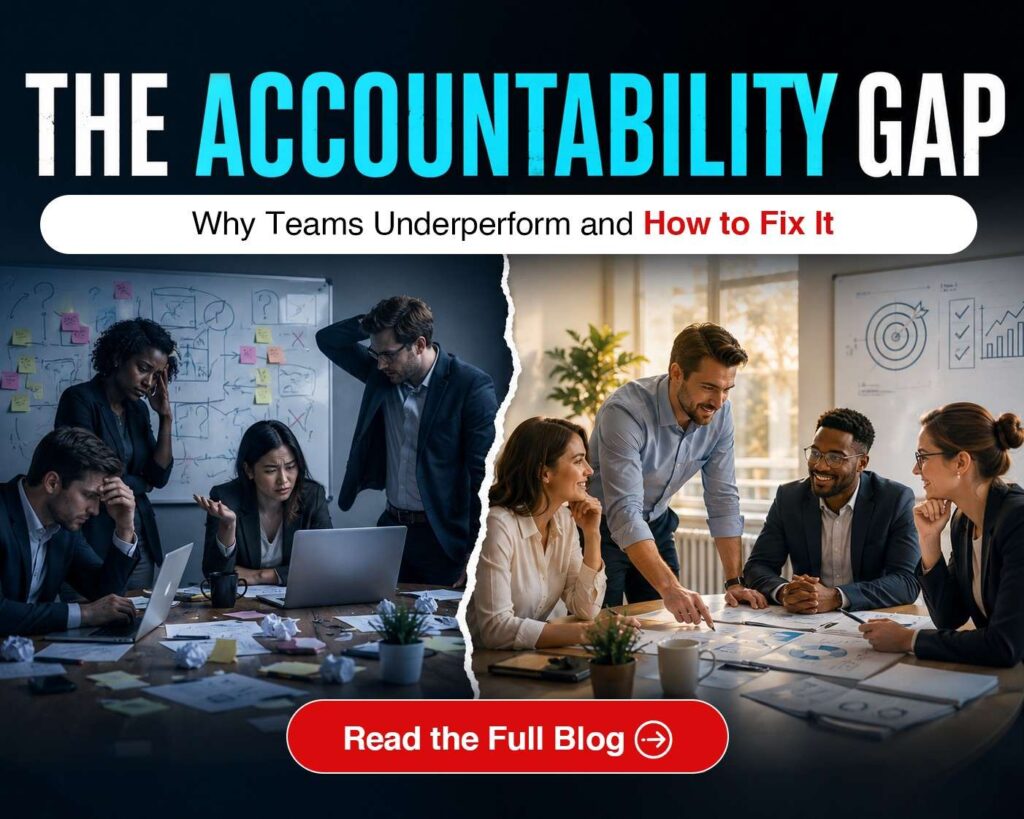

An owner recently told me, “My team is good, they know what to do, but somehow things just don’t get done the way I expect.” So I asked him straight up: “Do they know exactly what’s expected, by when, and what happens if it’s missed?” Silence. Then the honest admission slipped out: “Well, they should know.”
That gap between should know and actually knows that’s where most mid-sized businesses are quietly bleeding performance.
The Symptom Is Underperformance. The Disease Is Accountability.
When a sales team misses targets three months in a row, the instinct is to look at the market, competition is aggressive, demand is soft and product needs re-working. Sometimes that’s true. But more often, the real issue is sitting inside the organization not outside it.
I’ve walked into businesses where the sales manager couldn’t even tell me the team’s weekly call targets. The operations head had no idea what the owner expected for dispatch turnaround times, and the finance team was busy creating MIS reports that no one actually looked at when making decisions. Everyone was working hard, but not necessarily in the same direction.
Everyone was busy. Nobody was accountable – this is the Accountability Gap and it exists in almost every business that hasn’t deliberately built systems around performance.
Why This Happens in Mid-Sized Businesses specifically
In a small business, the owner is everywhere he sees everything. Accountability is enforced through his presence and not through systems.
As a business grows, the owner’s personal touch naturally becomes harder to maintain. They can’t be in every meeting, answer every call, or oversee every customer interaction. So they build a team, delegate responsibilities, and trust others to represent the business the same way they would. The problem isn’t delegation itself—it’s assuming that the standard will take care of itself. Without clear systems and accountability, consistency starts to fade.
No clear targets. No weekly rhythm of review. No consequence for missing, and no recognition for delivering. The team learns quickly that expectations are flexible. Deadlines are suggestions. And performance conversations happen only when something goes badly wrong.
The owner thinks he has a team problem. What he actually has is a systems problem.
The Accountability Gap shows up in Three Specific Places
Through our SURGE framework, Recharge Sales Teams is one of the five core pillars, and it’s where real transformation begins. Recharging a sales team isn’t about motivational quotes on the wall or occasional team outings. It’s about creating the right systems, processes, and support that allow people to perform consistently, stay focused, and deliver their best work every day.
1. Clarity of expectation
Most team members have a job description. Very few have a clear, written answer to what does good look like this month, in numbers? When targets are verbal, approximate, or carry-forwards from last year, accountability has no foundation. You can’t hold someone to a standard they never clearly agreed to.
2. Rhythm of review
Accountability isn’t a quarterly event. It’s a weekly discipline. Businesses that close their Accountability Gap have a simple rhythm – weekly numbers reviewed, gaps discussed, course corrections made before they become crises. Businesses that don’t have this rhythm discover problems at month-end, when it’s already too late to fix them.
3. Consequence and recognition
This is the uncomfortable one. In most mid-sized businesses, underperformance is tolerated because confrontation feels harder than the problem. Good performance goes unrecognised because the owner assumes the salary is recognition enough. Both are wrong. A team that sees no difference in how performance is treated will eventually default to the minimum. Not because they’re bad people because that’s what the system is rewarding.
What Fixing It Actually Looks Like
This isn’t about creating a culture driven by fear. That approach can be just as harmful. Instead, it’s about setting clear expectations, making performance transparent, and ensuring that regular conversations about both become a natural part of how the business runs. When everyone knows what’s expected and where they stand, it creates accountability, encourages growth, and helps the entire team move in the same direction.
Start with one thing. Take your top five to eight people, the ones who run your key functions. Sit with each of them and agree on three to five measurable outcomes for the next 90 days. Not activities. Outcomes. Not “visit more retailers – “add 15 new active retail counters in the territory with minimum billing of 10k.”
Write it down. Share it. Review it every week for ten minutes.
That’s it. That one change – clarity plus rhythm, closes a significant part of the gap within a quarter. I’ve seen its impact on revenue; I’ve seen it reduce owner involvement by 30 to 40 percent. I’ve seen teams that were labeled as underperformers start delivering consistently, simply because they finally knew what delivering meant.

The Hard Truth About Accountability
Accountability gaps don’t fix themselves neither they get fixed by hiring better people into a broken system.
The most common mistake I see owners make is replacing people before fixing the environment those people are working in. The new hire walks into the same unclear expectations, the same missing review rhythm, the same culture where performance has no consequence and six months later, the owner is frustrated again.
The system shapes the output. Fix the system first.
Most teams don’t underperform because they lack commitment. More often, it’s because expectations were never clearly defined. If people don’t know exactly what success looks like—backed by clear goals, measurable numbers, and consistent guidance—they’re left guessing. When everyone understands what’s expected and receives regular follow-through, performance naturally becomes more consistent and improves over time.
That’s your job as the owner. Not to do their work. But to build the structure that makes doing the work impossible to avoid.
If your business depends more on your presence than your systems to stay on track, that’s the starting point worth examining. A structured diagnostic conversation at MIH will give you a clear picture of where the gaps are. Visit our website www.make10xhappen.in